Sunday, 21 December 2014

A mixed year: Lord Bonkers in 2014

January

A headline from a 1922 edition of the New York Times returned to prominence:

Three Englishmen Saved from Boiling Pot By Cannibal Chief, Who Was Friend at Oxford

At dinner one evening Lord Bonkers commented to me:
That is the great thing about public school and varsity: your friends will help you out in later life if you find yourself in hot water. 
Incidentally, too much is made of cannibalism in the South Pacific. In my experience of those lovely islands, it was rare. 
The same, unfortunately, cannot be said of the Upper Welland Valley.
That same month, Lord Bonkers took up his new role as the Liberal Democrats' new pastoral care officer. He wrote:
Reading from my early volume Frank Chats for Young Canvassers, I say: “Now that you are growing up, I expect you find yourselves doing things like cutting out photographs of Megan Lloyd George from the News Chronicle. 
Let me reassure you: there is nothing wrong with such feelings. However, it is important that we do not allow them to get in the way of our Liberal activism. So rise early, take a cold tub, exercise with Indian clubs and then, if you still find yourself troubled by impure thoughts, ask your branch secretary for an extra Focus round to deliver. I assure you that, after that, you will have no energy left for beastliness of any sort.”
March

His lordship acquired a new heroine:
At a reception this evening I find myself talking to a charming lady by the name of Miriam-Gonzalez-Durantez. She turns out to have trenchant views on the public schools. “Some people from some of these top schools are fantastic but there are lots of people from these top schools who are unimpressive,” she tells me. “Quite right, my dear,” I reply. She goes on: "I know far too many that come out of there without speaking a single foreign language." 
As I am observing that speaking a lot of languages isn’t everything and pointing to that fellow Clegg as a case in point, she suddenly recognises an old friend on the other side of the room and disappears from view. Nevertheless, I am convinced she is Sound. Why does one never hear her spoken of as a future leader of the Liberal Democrats?
April

The mysterious disappearance of a Malaysian jet put Lord Bonkers in mind of an incident from the 1920s:
One bright April morning the 11:15 for Northampton Castle left Nottingham London Road Lower Level as usual, but it never reached its destination. It was seen to call at Melton Mowbray North, and there were unconfirmed reports of it reaching Clipston and Oxendon, but one thing is sure: it never arrived in Northampton.
May

Despite Lord Bonkers' best efforts, the Liberal Democrats fared badly in the month's European elections. He is pictured here, during the campaign, with our East Midlands candidates Phil Knowles and George Smid:
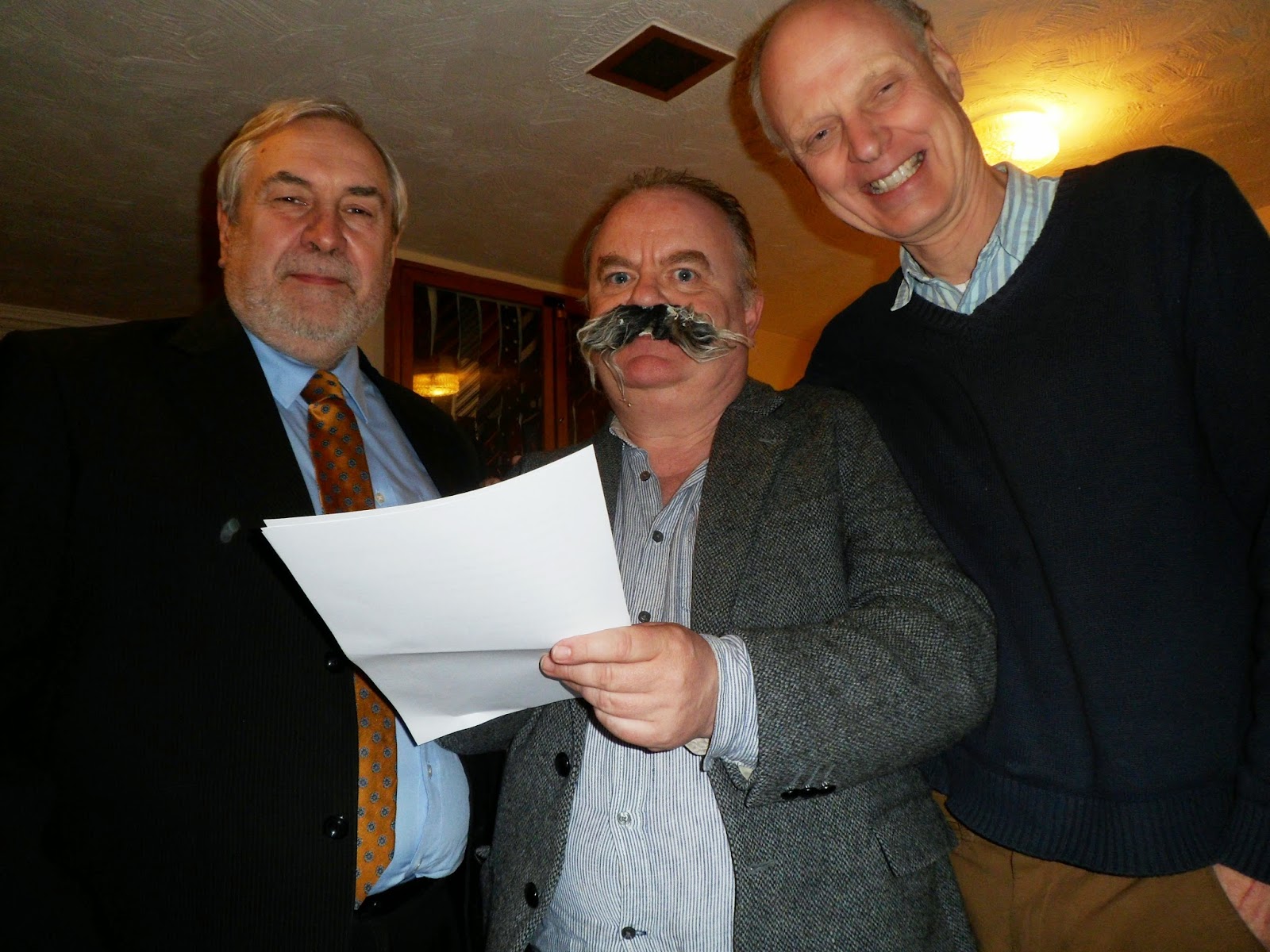

Later that month Lord Bonkers gave his recollection of the death of T.E. Lawrence:
It later transpired that he died in a motorcycle accident after, uncharacteristically, swerving to avoid two schoolboys.
June

This months Lord Bonkers met Freddie and Fiona from Nick Clegg's office:
“We’ve been told to organise a press event in a pub this morning so that Mr Clegg and Vince Cable can have a drink together and show they are really best friends despite what everyone says,” they explain. “But the trouble is, we don’t know how to do it.” “Why ever not?” I ask. “Because we are too young to go into pubs.”
August

And he met them again a couple of month later:
They are taking turns with a bicycle pump, attempting to get some air into a large balloon that has had a collection of bristles stuck on it. “Whatever is that, you two?” I ask. “It’s an inflatable Julian Huppert,” they explain.
September 

Events in Cardiff attracted the old brute's attention this month:
I am delighted to read that the Welsh Liberal Democrats are proposing to abolish the trolls on the Severn Bridge. For many years I have been urging just this move upon them, but without any joy. “The time is not right,” said Mike German. “There are other priorities,” said Kirsty Williams. “Wibble, wibble: are both those feet mine?” said Lembit Opik.
December

We were treated to some memories of the glory days of Oakham Studios:
I helped win a contract from the Association of Liberal Councillors to make a number of training films. More than one prominent member of our party learnt electioneering from watching ‘Confessions from a Committee Room.’ ‘Confessions of a Canvasser’ and ‘Confessions of a Knocker Up’.
And Lord Bonkers also offered some thoughts on (I think) the fall of Alastair Cook:
One has to be prepared to act decisively. For a leader who impressed people only a few years ago may no longer cut the mustard today.
Finally, he has asked me to assure you that there is no truth to the absurd rumours currently circulating about the financial position of the Bonkers Hall Estate.

Lord Bonkers' literary secretary blogs at Liberal England.

Monday, 8 December 2014

New website

Due to circumstances beyond our control, the Liberator website has gone down and will take some time to recover.

Meanwhile please redirect your browsers to our current home at http://liberatormagazine.org.uk/en/.

Thursday, 9 October 2014

The Federal Executive: Recovering from Omnishambles

Mark Pack at http://www.markpack.org.uk/75271/five-things-federal-executive-learn-mistakes/ has written a typically perceptive account of the travails of the Liberal Democrats' Federal Executive, which had a pretty torrid Conference.  He makes a number of suggestions as to how relations could be mended.

Rounding off the omnishambles was the declaration twice from the podium that the FE wanted to use the final pre-election conference in Spring not to promote Liberal Democrat policy commitments in the Manifesto, but to indulge in internal navelgazing by returning to the two sets of constitutional amendments it should have put to Glasgow Conference - but failed to; as well as the interim peers proposals which Conference Committee didn't take for debate at Glasgow, as debating who should go into the House of Lords wouldn't have had any effect on this autumn's elections but would have looked strange to the outside world when so many of the party's Commons seats are reportedly under pressure.  It would say something about the priorities of the current committee if they do decide to proceed with this rather than wait until the post-election conference at Liverpool, where there will be ample time for more introspective discussion.

Into the mix should also be thrown the Federal Finance and Administration Committee (FFAC): unelected but powerful, and particularly opaque.

As elections for Executive and President draw near, it focuses attention on three things.
1. The listening mode.  Individually many members of the FE are good at listening, but this is not reflected collectively.  Dissident voices never seem to make themselves known within the wider party.  This does not help the FE's image.  Both recent gaffes (on OMOV and gender quotas) where the committee failed for various reasons to heed advice, are results of this.
2. The purpose of the FE itself.  Gordon Lishman said from the podium that the gender quotas decision - arguably illegal - was rushed through after the guillotine at the end of a long meeting without debate.  How many of the earlier items were essential?  It has a long track record of discussing trivia while not focusing on key issues of strategy which is what it is supposed to be about.  As Mark says, even its own members seem to be unaware of some decisions taken in their name.
3. Mend fences where necessary.  This should go without saying.

The questions to be asked of candidates for FE and President - and their responses - will be important.  You can of course read questionnaires with the latter in the latest Liberator.

Thursday, 2 October 2014

Constitutional Farce

It appears that the Federal Executive has caught itself with its constitutional trousers down, as is about to become apparent in some form in Glasgow.

In a rather desperate attempt to evade the <a href="http://www.markpack.org.uk/68347/omov-the-fe-has-submitted-a-mess-to-conference-so-lets-sort-it-out/">technical reference back set out by Mark Pack</a>, who has set out in the same post the shortcomings of the proposals, the FE has submitted a lengthy set of further amendments to the constitution and Standing Orders.  They make for interesting reading, partly as they contravene the Party's constitution by introducing new material, and partly because they fail to deal with some of the key shortcomings of the original proposals.

The Federal Conference Committee might have something interesting to say about the amendments to standing orders..... especially as the committee was not shown them in the first place.  Had they seen them, FCC members would have thrown them out on grounds that they were incomplete, contradictory and ambiguous.  As it is,  it’s surely not acceptable for the movers to rewrite their own motions so extensively - which of course, among other things means that conference can’t amend the new material the FE introduce through their amendments.

Thursday, 4 September 2014

Simon Titley has passed away

Simon Titley passed away this weekend, following the news in June that he had been taken ill.  He will be missed terribly by the Liberator Collective, those who enjoyed the Liberal Revue, and many people beyond whose lives he touched by his wit, incisive writing and instinctive, passionate Liberalism.

Originally from Lincolnshire – a heritage of which he was always proud – he went to Keele University, becoming a ‘highly political’ sabbatical officer.  For a long time he worked for the Liberal Party’s central organisation, moving to work for the GLC's successor organisations and finally organising Paddy Ashdown's tour for the 1992 General Election before eventually being coaxed away by the lure of PR.  He preferred the world of the political backroom, but did stand for Parliament once, in Grantham in 1983; as a local eccentric still shot silent newsreels for the town's cinema and filmed one of Simon's campaign meetings he thought he was probably the last UK general election candidate ever to appear in a silent film.  Preferring policymaking (serving on the Europe policy working group until last year) and commentary, his unwavering commitment to numerous personal political causes [Europe and Palestine two constants] always came first, sometimes to the detriment of his career.

Although Simon started to contribute to Liberator in the late 1970s, he was only persuaded to join the Collective in 1985.  His close friend and Liberator Collective colleague Mark Smulian describes Simon’s relationship with him and the magazine:

•
The first time I met Simon I inadvertantly nearly poisoned him as it turned out the cheese used to stuff rolls at a Liberal student conference in 1977 had spent the night in an underground car park and was thus richly flavoured with petrol fumes.
Alarming as this was to such a noted gourmet, it was start of a long friendship. Simon had contributed to Liberator from the late 1970s but became fully involved around 1985 when he found a book review he’d written had been insensitively edited. On being told this was to make room for a picture of a cat, Simon – fond as he was of cats – decided the only way to prevent such future vandalism was to join the collective.
From then on he, without imposing himself, provided much of Liberator’s political direction and its most telling analysis of events…. he despaired of the Liberal Democrats failure to build a core vote and to instead chase transitory grievances and split the difference in the ‘centre’.
Simon was noted for his love of fine food, wine and beer. He was deeply serious about politics, yet a satirist of great ability and the driving force behind establishing the Liberal Revue, which entertained conference goers on and off for 24 years.
He had a vast collection of erudite books on politics and economics, yet his favourite entertainment was the innuendo-strewn 1960s comedy show Round the Horne.
Simon leaves a huge gap not only in his family and friends’ lives but in the party’s resources for thinking about its future.

While the volume and quality of Liberal publications has declined considerably, even more so since Conrad Russell’s departure a decade ago, Simon fought what was almost a one-person campaign to keep the processes of Liberal thought going. His publications included Really Facing The Future [with David Boyle, 2011], a direct challenge to the party’s attempt to set out a policy programme in ‘sterile and detached language’.  He contributed to Reinventing the State, the 2007 social liberal response to the Orange Book.  His regular contributions to Liberator were supplemented by two periods of prolific blogging on all manner of topics.  His 2004-5 foray as the Liberal Dissenter was supplemented by more recent work on this blog.  

As Mark says, the culture brought to the Liberator and Liberal Revue teams by Simon was distinctive too.  Days out or even occasional weekends away were characterised by his love of the finest food and where possible a visit to the nearest record shop (politics is not the only interest we shared).  Simon was unafraid to stand up against tired received wisdom and lazy thinking – or confront those guilty of either.  The irony of some of those who whined about his blunt observations joining those mourning is not lost on some of us.  However, they are in exalted company.  Vince Cable has written this tribute:

•
Like many people in the party, I have been greatly saddened to see the passing of Simon Titley, long before his time.

He was in Liberator especially a tough irreverent critic of the party establishment and of conventional thinking.

I want to record my appreciations of his insights, originality and sharp wit. I benefitted personally from his advice and what he had to say was always thoughtful, considered and helpful. He will be greatly missed.

As Mark and Simon say, Liberalism and Liberal thought in particular are weaker today.